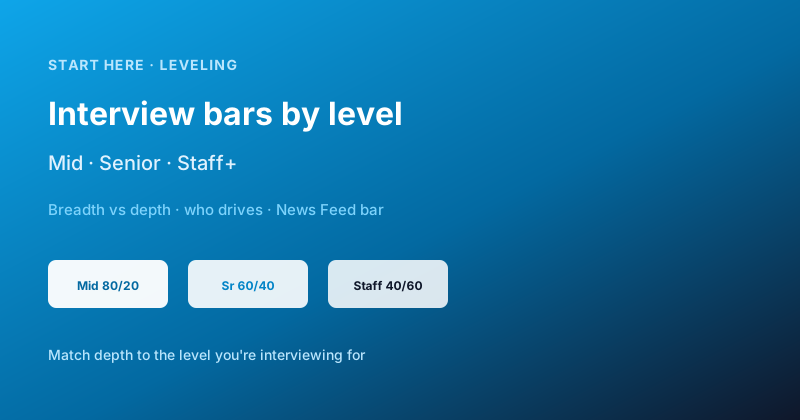
How to use this plan
Know every round type
Jump into Lattice series
APIs → queues → auth
6-week or 2-week sprint
Strong vs weak signals
Checklists + failure modes
How Lattice is organized (so you don’t get lost)
Curriculum = full loop
Short curated paths
Indexes, not textbooks
Where you practice
Analogy: five rooms in one building
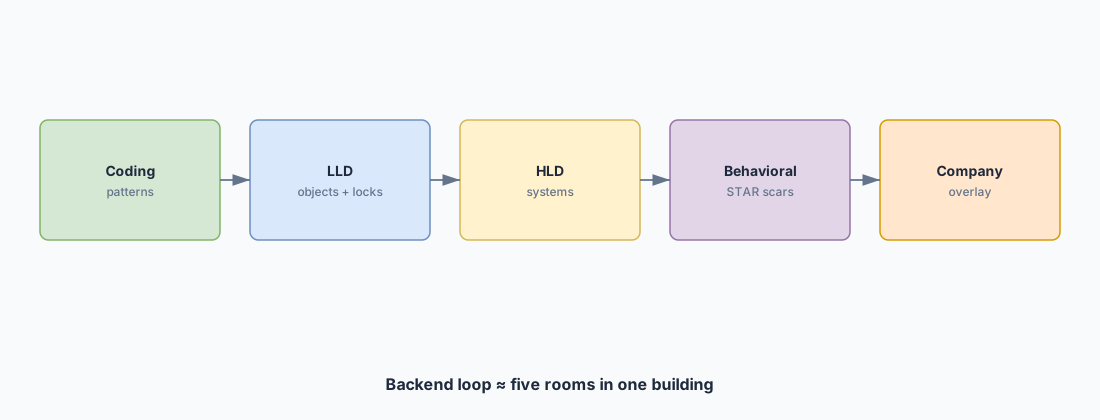
A backend loop is one building with five rooms. You don’t renovate the company room before you can walk through coding and design. Skills are the floors; company guides are the wallpaper.
Backend loop map — what rounds exist
Most backend SWE loops are the same shape with different company seasoning. Map your recruiter’s email onto these five buckets so you never prep the wrong skill.
Timed coding · sometimes work-sim
1–2 mediums · shared editor
Classes · APIs · concurrency
Scale · data · failure
STAR · LPs · values
Veto or packet review
- Coding only screen → Coding
- LLD / OOD → LLD
- System design → playbook + foundations + practice
- Behavioral / LP / Googliness → Behavioral
- Bar raiser / HC anxiety → company guide + staff Q&A + level bars
Skills checklist — links into Lattice
Treat this as your homepage. Open the series, finish the framework post, then drill. Don’t collect tabs.
- Coding — /series/coding: roadmap → windows → search → structures → graphs → DP
- LLD — /series/lld: overview → framework → OOP → patterns → concurrency → classics
- Core concepts — /series/core-concepts: numbers, networking, APIs, indexing, CAP, consistency
- Technologies — /series/technologies: Postgres / Mongo / Dynamo · Redis · queues · Kafka
- Patterns — /series/common-patterns: caching, rate limits, async, sharding shapes
- Question breakdowns — /series/question-breakdowns: URL shortener, rate limiter, feed, chat, ticket systems
- Behavioral — /series/behavioral: STAR → big three → conflict → staff Q&A banks
- Company guides — /series/company-guides: Amazon · Google · Meta · OpenAI · Intuit · LinkedIn
Must-know backend topics checklist
If you can teach each item in two minutes with a tradeoff, you’re interview-ready. Link hop when a gap shows up in a mock.
REST · errors · versioning
When each wins
B-tree · selectivity
ACID · isolation
TTL · stampede
Locks · counters
At-least-once
Keys · retries
R+W · CAP
Token · sliding
Cursor vs offset
Tokens · scopes
- APIs — status codes, idempotent verbs, pagination, error envelopes. Deep dive: API design, networking essentials.
- SQL vs NoSQL tradeoffs — joins & transactions vs flexible docs & horizontal scale. Compare Postgres, MongoDB, DynamoDB; model with data modeling.
- Indexing — what an index buys you, covering vs non-covering, write amplification. Database indexing.
- Transactions & isolation — dirty/non-repeatable/phantom reads; when you need serializable vs read committed. Tie to consistency models.
- Caching — cache-aside, write-through, TTL, stampede, invalidation. Caching strategies · distributed cache design.
- Redis patterns — counters, rate windows, distributed locks (and when locks lie), sessions. Redis.
- Queues / Kafka — at-most/at-least/exactly-once myths, consumer groups, DLQ, ordering by key. Message queues · Kafka.
- Idempotency — idempotency keys on writes, dedupe tables, safe retries. Say it in every write-path design.
- Consistency — CAP intuition, quorum, read-your-writes. CAP · consistency models.
- Rate limiting — token bucket, sliding window, where to enforce (edge vs service). Design a rate limiter · LLD rate limiter.
- Pagination — offset drift vs cursor/keyset; stable sort keys.
- Authn / Authz (brief) — sessions vs JWTs, refresh, scopes vs roles; never invent crypto — name the trust boundaries.
6-week backend schedule (daily targets)
Assumes ~90–120 minutes on weekdays + one longer mock block on weekends. Adjust intensity, not order.
2-week intensive schedule
For when the loop is already on the calendar. Drop perfectionism; protect mocks.
Roadmap + weakest patterns
Framework + 2 classics timed
Playbook + numbers + 2 designs
Cache · queue · consistency aloud
6 STAR stories + company values
Guide + 2 full mock days
Weakest round only
Day-before list
- Days 1–2: Coding roadmap — only patterns you fail under 20 minutes. 3 timed mediums/day.
- Days 3–4: LLD framework + rate limiter + one game/booking classic. Narrate STAR while coding classes.
- Days 5–6: Delivery playbook + URL shortener + one harder design from practice.
- Days 7–8: Teach the must-know backend list to a rubber duck; skim technologies gaps only.
- Days 9–10: Behavioral catalog + company-specific values (LPs / Googleyness / Meta / mission).
- Days 11–12: Two full mock days matching your company loop; read your company guide cover to cover.
- Day 13: Only the round you scored weakest. Sleep early.
- Day 14: Light review of notes; run day-before checklist. No new topics.
Mock rubric — strong vs weak
Score each mock 1–4 per round. Hire packets are built from these signals — practice sounding like the strong column.
Day-before and day-of checklist
Notes · stories · sleep
Env · water · pace
Failure modes — how backend candidates fail loops
These are the patterns I see most in reject feedback for backend loops. Audit yourself against the list before you blame “luck.”
- Silent coding — strong solution, zero narration → weak collaboration score.
- No numbers in HLD — pretty diagram, no QPS/storage/latency → junior signal.
- Queue/cache cargo cult — Kafka/Redis without idempotency, ordering, or invalidation story.
- Ignoring consistency — “eventual” as a shrug; no read-your-writes or conflict plan.
- LLD without APIs — classes drawn, no method contracts or failure returns.
- Concurrency hand-wave — race conditions named but never locked/queued/versioned.
- Behavioral “we” — no personal decision, metric, or learning.
- Values theater — LP/value slogans without STAR evidence (fatal at Amazon BR / Google HC).
- Level mismatch — L5-scope design in an L6 loop (single service, no migration/org).
- Time mismanagement — perfect first 20 minutes, empty last 15 (no tests / no deep dive).
- Fighting the interviewer — rejecting hints; debating requirements instead of shipping a design.
- Over-prep, under-mock — 40 articles, 0 timed sessions. Delivery is the skill.
Recommended order (full loop)
- Coding — pattern path
- LLD / OOD — framework → classics
- System design — playbook → foundations → patterns → practice
- Behavioral — STAR + staff banks
- Company — Amazon / Google / Meta / OpenAI / Intuit / LinkedIn / Microsoft
- Offer — salary negotiation
Daily / weekly rhythm (steady state)
- Daily (60–90m): 1 coding pattern drill + 1 timed problem
- 3× week: one 35-min LLD or 45-min HLD on a timer
- 2× week: one STAR story out loud (record phone)
- Weekly: one full mock matching your company loop