Why consistency matters
Consistency is the story of what a user sees after a write — and what other users see, and when. Get it wrong and you either overpay in latency for data that didn't need it, or you ship confusing UX (and angry WhatsApp forwards) for data that did.
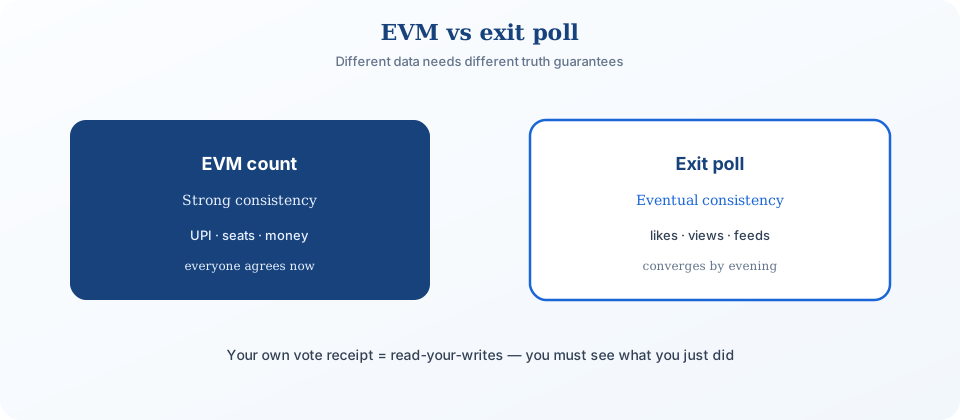
In distributed systems, every replica is a slightly different photograph of reality until they catch up. Your job in an interview is to decide which photographs the product can tolerate — and for how long. That decision is not “pick strong because it sounds safer.” It's “name the blast radius if this number is wrong for thirty seconds.”
Ask what users must see before naming models.
Strong → RYW / monotonic → eventual.
Money strong; feeds eventual; cart RYW.
Partition forces a pick; real products mix.
How to say this in the interview
When consistency comes up, lead with a spoken paragraph that sounds like a product conversation — then attach model names. Almost memorize this shape:
That paragraph shows hybrid thinking without a CAP monologue. Juniors often pick one model for the entire system; seniors split by record type and blast radius. If the interviewer wants theory next, you've already earned the right to say linearizability or quorum without sounding like a flashcard.
Speak product, then theory
Anchor every consistency choice in a product question. Theory without a user story sounds like a textbook dump. The questions below are your checklist before you say “eventual” or “strong” out loud — answer them first, then pick the label that matches.
- Own write visibility — Can a user see their own write immediately?
- Cross-region lag — Can two regions show different numbers for a minute?
- Money path — What happens to payments if the network splits?
- Stale UX — Is a slightly wrong like-count embarrassing or catastrophic?
Notice how these are all user-visible or money-visible outcomes. Interviewers trust you more when you sound like you're protecting a customer, not optimizing a paper. If two regions can disagree on a like count for a minute, say so — and say why that's fine. If they can't disagree on a wallet balance, say that too, and accept the latency cost.
Lead with what the product must guarantee for the user, then name the consistency model that matches.
Models you should own
These four cover almost every interview. Place them on a spectrum from “always latest” to “converges when it can.” You don't need twenty paper definitions — you need to place a product requirement on this line and explain the cost of moving left or right.
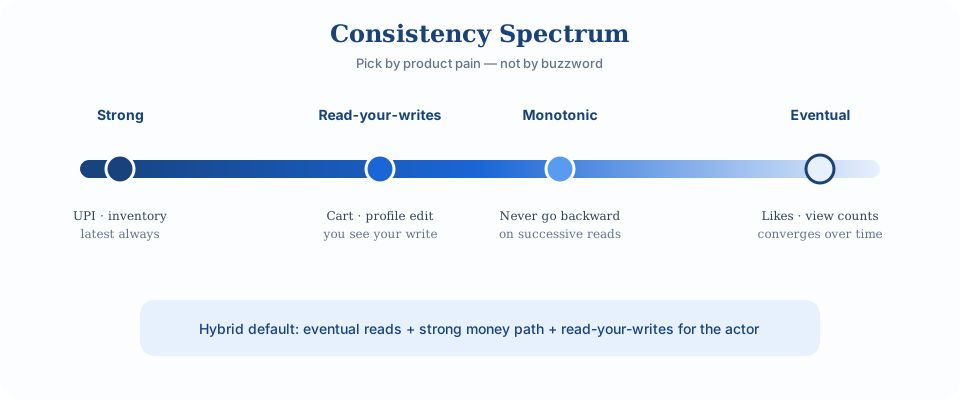
Strong consistency means a reader always sees the latest committed write — great for ledgers, expensive at global scale because you wait on coordination. Eventual consistency means replicas converge when they can; you buy availability and latency, and you owe the product a staleness story. Read-your-writes sits in the middle for the author: the writer sees their own updates even if the world lags. Monotonic reads prevent “time travel” — successive reads never move backward, which matters for feeds and dashboards where a number flipping older feels broken.
- Strong consistency — readers always see the latest committed write. Cost: latency and availability during partitions.
- Eventual consistency — replicas converge over time; temporary staleness is allowed.
- Read-your-writes (RYW) — the writer always sees their own updates, even if others lag.
- Monotonic reads — you never move backward in time on successive reads (no “time travel” UX).
Strong is expensive at global scale. Eventual is cheap but needs clear UX for staleness. RYW is often the sweet spot for social and shopping: the author sees truth immediately; the world catches up. If you only remember one interview move: don't argue strong vs eventual for the whole app — argue it per surface.
Own strong, eventual, read-your-writes, and monotonic — and place each on a spectrum with a cost story.
What juniors get wrong vs what seniors say
Consistency isn't a dial you crank to max — it's a promise you make per feature.
Consistency interviews go sideways when candidates treat the spectrum as a personality test (“I'm a strong-consistency person”). Seniors treat it as a blast-radius spreadsheet.
- Junior — “We'll use strong consistency everywhere so data is never wrong.” Senior — “Strong on the ledger and inventory; eventual on social aggregates with RYW for the author — otherwise every like pays cross-region latency.”
- Junior — “Eventual consistency means we don't care about correctness.” Senior — “It means we define a convergence window and UX for staleness — wrong forever is a bug, wrong for 2 seconds might be fine.”
- Junior — “CAP says we must pick C or A for the company.” Senior — “CAP is per data under partition; payments might be CP while the feed stays AP.”
- Junior — “Read replicas give strong consistency.” Senior — “Replicas are typically eventual unless you read from primary or use sync replication with its latency cost.”
A failure story that sticks: a shopping app cached cart totals aggressively. After checkout, users refreshed and still saw items in the cart for ~30 seconds because the edge cache ignored the write. Support tickets exploded — not because money was wrong, but because read-your-writes was broken on the one surface users check obsessively. The fix wasn't “make everything strongly consistent”; it was sticky reads / cache bust on the user's cart key. Fix the guarantee that was actually violated, not the whole architecture.
Juniors pick one model for the company; seniors pick per record type — and they know broken RYW feels like a product bug even when the ledger is fine.
When to use what
The interview move: tie consistency to business impact, not textbook definitions. Different records on the same platform can sit at different points on the spectrum. Walk through the list below as if you're reviewing a PR for “is this data allowed to be stale?”
- Social likes / view counts — eventual is fine; near-real-time beats perfect.
- Bank balance / UPI transfer — strong or linearizable on the ledger record.
- Shopping cart — read-your-writes so the user sees what they just added.
- Game leaderboard — eventual + short TTL; speed matters more than perfect order.
- Inventory for flash sales — strong (or carefully designed contention control) on remaining stock.
Flash sales deserve an extra sentence. If two users can both “buy the last seat” because stock was eventually consistent across regions, you didn't save latency — you bought refunds and trust damage. Inventory and payments are where strong consistency (or explicit locking / reservation) earns its keep. Likes are where you should refuse to pay that cost.
The distinction is the record, not the domain. A ticketing platform's day-one trade estimates get revised all week without anyone panicking, but a ticket a user already bought must never disappear from their account. Same platform, two different consistency bars — reporting numbers can drift, ownership records can't.
Match consistency to blast radius — money and inventory go strong; social aggregates can go eventual with RYW for the writer.
CAP — read this elsewhere
CAP is about choosing consistency vs availability during a network partition. This article focuses on consistency models (strong, eventual, read-your-writes) — the day-to-day product trade-offs. For the partition thought experiment, read CAP theorem first if you haven't already.
Hybrid defaults (what real products do)
Most consumer products pick availability + eventual consistency for reads, and strong consistency for money-moving writes. Hybrid beats pure either-or. The architecture usually looks like separate stores or separate code paths — not one dial labeled “consistency = 7.”
- Separate stores — transactional DB for payments; eventually consistent cache/index for feeds.
- Sticky reads — route a user to the replica that saw their write (RYW without global strong).
- TTL windows — accept staleness for N seconds with an explicit product OK.
- Repair paths — background reconciliation when AP writes diverge.
Sticky reads and short TTL windows are how you get RYW without making every read hit a global primary. Mention them when the interviewer pushes on “but how do you implement that?” — it shows you've thought past the label.
This is the same split as the cart-refresh incident above: keep the transactional store strongly consistent for money and inventory, and let the read-heavy surfaces run eventual with read-your-writes for the author. One spoken paragraph and one architecture diagram cover almost every consistency question you'll get.
Default to hybrid: eventual + RYW for social surfaces, strong consistency for money and inventory.
Cost and performance levers
Consistency storyboard
Session guarantees cheat sheet
- Read-your-writes — see your own updates.
- Monotonic reads — never go back in time.
- Causal — respect cause→effect order.
Failure modes to mention
Call out at least one dependency failure (DB down, cache stampede, queue lag, region outage) and your mitigation (timeouts, retries with jitter, degraded mode, circuit breaker).
Interview Q&A by level
Practice saying these out loud for consistency models. Interviewers grade clarity and judgment more than buzzwords.
Match depth to the bar: define → trade off → operate. Don't dump principal answers in an entry-level screen.
How to answer this in a backend interview
Single global order — expensive
Per-client order preserved
Cause before effect; concurrent may diverge
Converge if no new updates
UX minimum for many products
I'd pick the weakest model that still makes the product correct. Read-your-writes is often the UX floor after a user posts. Causal fits collaborative edits and comment threads. Linearizability is for leader election, unique constraints across replicas, and money movement — and I'll say it costs latency and availability under partitions. Eventual consistency is fine for derived views if we show how conflict repair works. Naming the model beats saying 'strong consistency' vaguely.
Related Lattice posts: CAP theorem · Contention · Multi-step processes · ZooKeeper / coordination