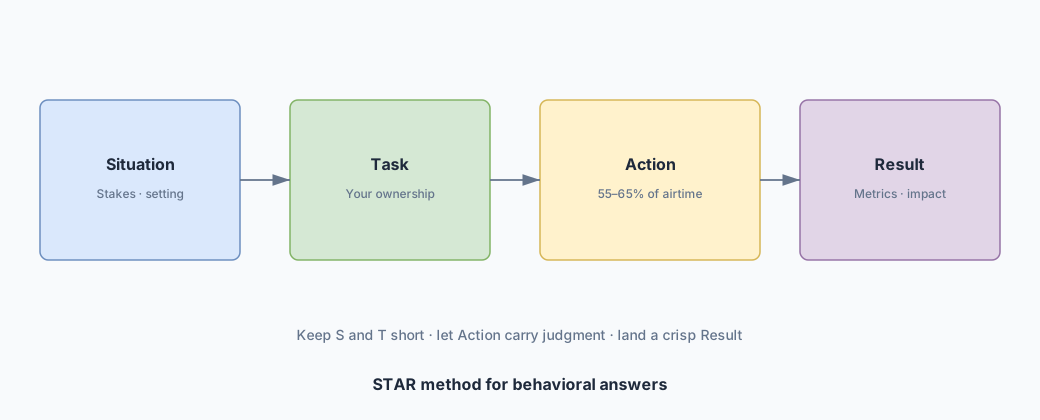
The shape (keep it light)
Stakes in 2–3 lines
Your job
Most of the airtime
Before → after
Analogy: a movie scene
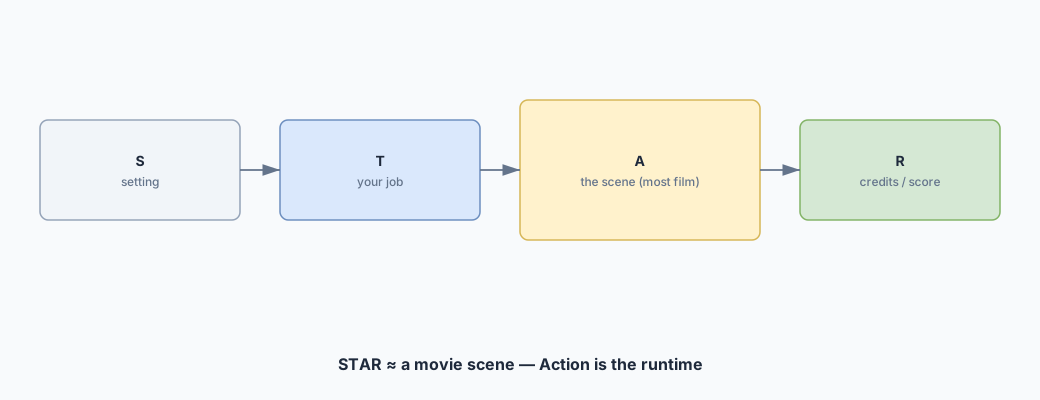
STAR is a short film. Situation/Task set the location and your role in two breaths. Action is the actual scene the audience paid for. Result is the score on the screen as the credits roll — numbers beat vibes.
Sample: stuck on a messy dependency
Prompt: Tell me about a time you pushed through a hard obstacle.
Sample: influence without a mandate
Prompt: Tell me about influencing a technical decision without authority.
More staff answers
Minute-by-minute timing (with example cuts)
Most staff behavioral answers should land in ~2:30–3:30. Longer only when the interviewer asks you to keep going. Below is a clock you can rehearse against — and what to cut when you overrun.
“We vs I” calibration
Interviewers are hiring you, not your squad’s highlight reel. But pure “I alone saved the quarter” sounds fake on staff work that is always multi-team. Calibrate deliberately.
- Bad: “We decided to build a platform.” (Who decided? What did you do?)
- Better: “I framed the duplicate-outage cost, then I offered a thin shared sender…”
- Bad: “I single-handedly migrated every team.” (Unbelievable at staff scope.)
- Better: “I migrated the first consumer myself, ran office hours, and tracked adoption weekly.”
Result metrics that sound real vs fake
Results don’t need to be vanity-board perfect. They need to be believable, attributable, and tied to the Action. Hiring managers have heard “10× latency, 99.99% uptime, millions of dollars” from every resume. Prefer the metric that ops or a partner team would recognize.
Sample: incident response (Sev that crossed teams)
Prompt: Tell me about a time you handled a production incident under pressure — especially one that involved more than your team.
Sample: mentoring that raised the bar
Prompt: Tell me about a time you mentored or unblocked someone — and the outcome stuck after you stepped back.
Story bank mapping (prompt → which story to pull)
Don’t invent a new epic per question. Keep a small bank and remap. Staff loops recycle the same eight signals; your job is to pick the right angle, not a new autobiography.
- Inventory sync / stock promises — ownership + perseverance
- Shared notification sender — influence + platform thinking
- Webhook / ledger Sev — incident command + customer path
- Design-review mentoring — growing others + leaving a system
- Partner-team charter fight — conflict + alignment
- AI-assisted migration plan — leverage with accountability
Common STAR failures checklist
Before the loop, read your stories against this list. Fixing one failure often upgrades the whole answer.
- Biography Situation — two minutes of company history before the problem.
- Team fog — only “we”; no clear decisions you owned.
- Action as status report — list of tickets, no tradeoffs or “I chose X because Y.”
- Missing constraint — no deadline, partner, or risk; sounds like a tutorial.
- Result without before — “it went well” with no baseline.
- Fake-sharp metrics — unmeasurable 10× claims you can’t defend.
- No scar — perfect hero arc; interviewers don’t trust it at staff.
- Wrong altitude — senior ticket story for an L6 room (no org leverage).
- Ignoring the question — forcing your favorite story when Decode said otherwise.
- Never stopping — past 4 minutes with no Result; interviewer tunes out.