
What are you trying to improve?
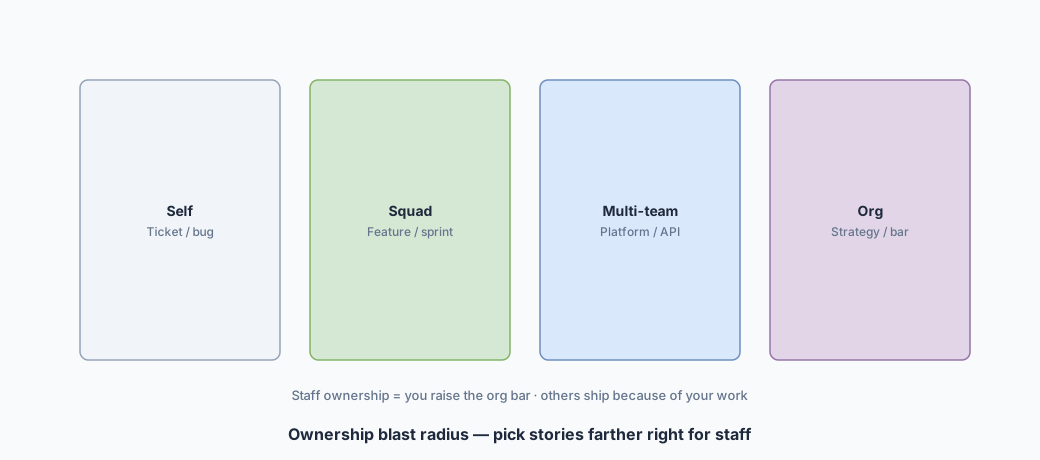
Raise the org bar.
Blast radius → right.
Speed + verification.
Spread the practice.
Question
What are you trying to improve most professionally?
Signal: Growth + ownership
What they really want: Self-awareness with a credible improvement system.
Staff growth: how you raise the org bar
Mid growth answers improve personal craft. Staff growth answers change how the organization works — review standards, incident culture, platform DX, hiring bar, or AI verification norms. Pick a real edge at the next scope, not a humblebrag.
If your improvement area only makes you a better ticket-closer, aim one ring out on the blast-radius diagram.
How do you learn new things?
Question
How do you approach learning new things?
Signal: Growth
What they really want: Is your learning tied to delivery, or infinite tutorials?
Most rewarding part of building
Question
Describe the most rewarding part of developing something.
Signal: Ownership + values
What they really want: What do you optimize for — users, craft, team leverage?
AI questions in behavioral loops
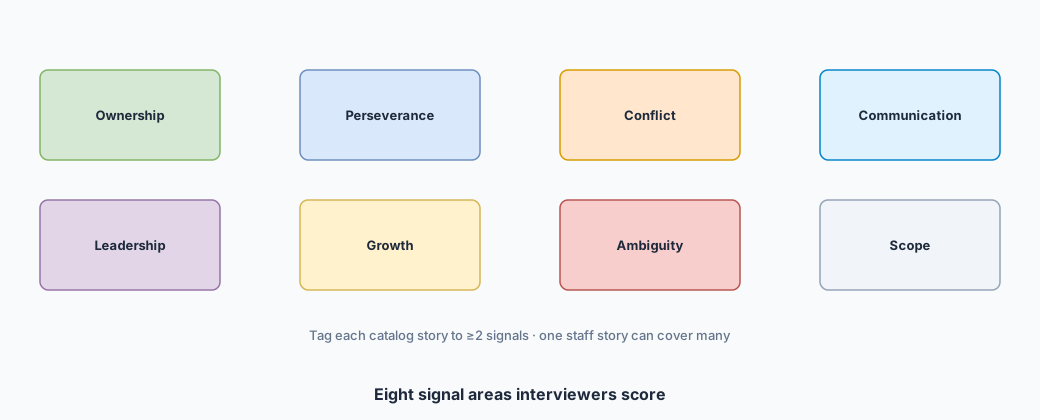
Companies now probe AI fluency. Interviewers often scan five areas: Work (what you built), Trust (how you verify), Iteration (how you improve prompts/tools), Growth (how you stay current), Scaling (how you spread practice).
Question
Tell me about a time you used AI to deliver something you couldn’t have otherwise.
Signal: Ownership + AI work/trust
What they really want: Judgment: speed with verification, not blind paste.
- Follow-up: How do you decide what not to trust AI with?
- Follow-up: How did you share the workflow with the team?
Question
How do you think about speed vs verification when working with AI?
Signal: Trust + judgment
What they really want: Do you have principles, or vibes?
AI at staff: leverage with accountability
Interviewers probe five areas: Work, Trust, Iteration, Growth, Scaling. At staff, “I use ChatGPT daily” fails. They want judgment about where AI accelerates delivery, how verification is encoded, and how you spread safe practice.
- Work: a deliverable that was impossible/late without AI assist.
- Trust: tests, dry-runs, secret hygiene, human gates on money/auth/deletion.
- Iteration: evals / golden fixtures improved over time.
- Growth: how you stay current without thrashing every model drop.
- Scaling: team guide, templates, or workshop — AI practice as org asset.
A one-week practice plan
- Day 1–2: Journal 3 core stories; tag signal areas.
- Day 3: Write STAR bullets (not scripts) for TMAY, proud project, conflict.
- Day 4: Record yourself; cut context that fails the 30-second rule.
- Day 5: Mock with a friend — only follow-ups allowed after each answer.
- Day 6–7: Add feedback + AI stories; refresh metrics.
Inventory your AI practice before the interview
Before the loop, write one bullet for each area interviewers probe:
- Work — a deliverable AI helped you finish faster or make possible.
- Trust — how you verify (tests, dry-runs, human review, secret hygiene).
- Iteration — how you improved prompts, evals, or tooling over time.
- Growth — how you stay current without thrashing every shiny model.
- Scaling — a doc, template, or workshop you used to spread good practice.
More ownership samples
Question
Tell me about a time you saw a problem and fixed it without being asked.
Question
Tell me about a tool or workflow you adopted in the last six months.
Closing advice
Behavioral prep is not motivational posters. It is evidence engineering: decode the signal, select scoped stories, deliver Action-heavy STAR, and land a Result that proves you compound.
Read next: Decoded · STAR · Big three · Conflict & feedback.
Raising the org bar (and AI)
Staff growth stories show you changed how the org learns: review culture, incident templates, hiring bars, platform docs. On AI: say what you automated, what you still verify, and how you kept accountability when the model was wrong.
Growth, ownership & AI pitfalls
- Growth as hobby list — courses and blogs with no work artifact changed.
- Fake humility — “I care too much” / “I work too hard” as a weakness.
- AI as magic — “I use ChatGPT for everything” with no verification story.
- AI denial — pretending you’ve never used it when the room expects judgment.
- Ownership = volunteering for tickets — staff ownership is defaults and blast radius.
- Learning with no transfer — you learned; the team’s path didn’t get easier.
Follow-up sparks: growth, ownership, AI
Rehearsal checklist: growth & AI
Follow-up Q&A — growth, ownership & AI
After a growth or AI behavioral answer, these probes show up constantly.