
Why this round decides the hire
What are they testing?
Match the altitude.
STAR · Action-heavy.
Org leverage or downlevel.
The behavioral round is the culture-fit / judgment interview — “Tell me about a time…” — often run by a hiring manager. They are not collecting war stories for fun. They are checking whether your habits would create the same outcomes on their team.
That is why candidates who crush coding still hear: “manager didn’t like the fit,” “weak for E5 / L5,” or “try another team” that never materializes. Technical skills can be taught faster than ownership, conflict habits, and communication under ambiguity.
Three lenses interviewers use
Almost every behavioral question is scored through some mix of these:
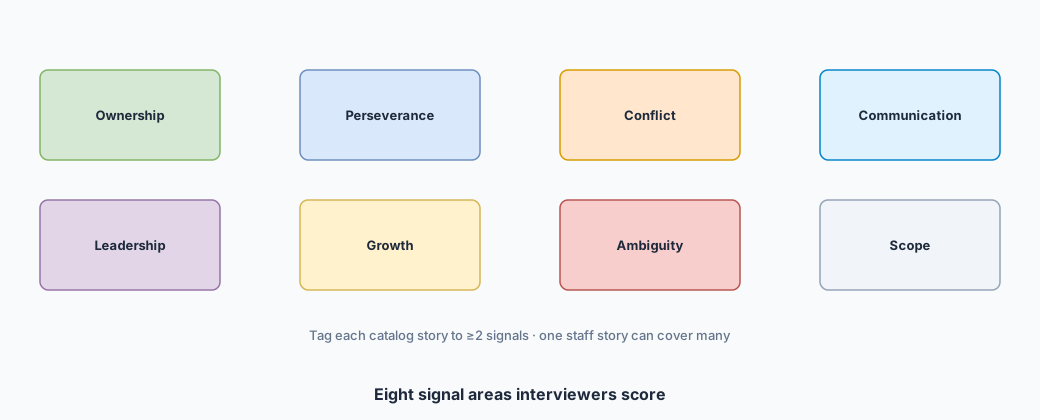
- Signal areas — ownership, conflict, perseverance, communication, leadership, growth, ambiguity, scope.
- Company values — Leadership Principles, “Move Fast,” “Focus on the user,” etc. Same underlying behaviors, different vocabulary.
- Cultural fit — how work actually gets done there: pace, documentation, debate style, data rigor.
Eight signal areas to map your stories
Build a short catalog (3–5 core projects + a few fillers) tagged to these areas. One strong story can cover several signals.
- Ownership — you drove outcomes without being asked; you closed the loop.
- Perseverance — you hit a real wall and adapted until it moved.
- Conflict resolution — disagreement with a peer/PM/partner; you sought shared goals.
- Communication — you aligned stakeholders, wrote the doc, ran the hard conversation.
- Leadership / influence — people followed your judgment without formal authority.
- Growth / coachability — feedback changed your behavior; you can name the before/after.
- Ambiguity — unclear goals; you created structure and shipped anyway.
- Scope — the size of problem, blast radius, and time horizon match the level you want.
A simple loop for every question
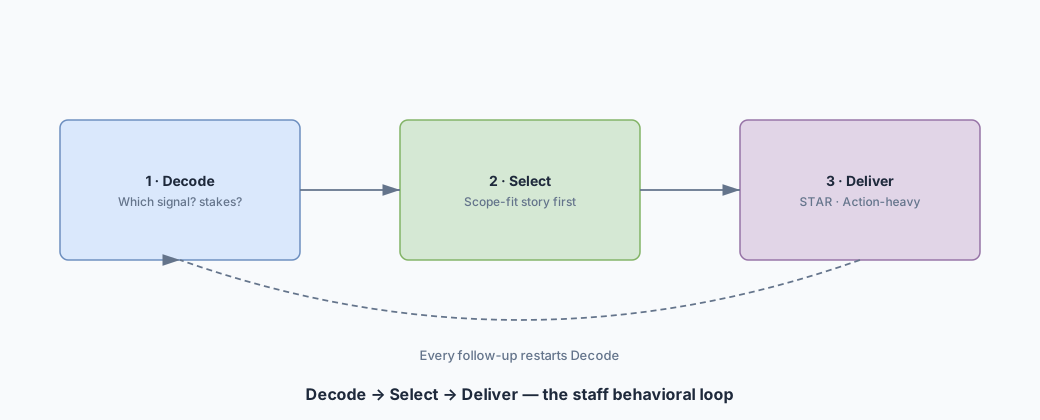
Decode. Pause 3–5 seconds. Ask: which signal is this probing? “Challenging project” ≠ “interesting architecture” — it usually wants perseverance and stakes.
Select. Pick the story with the best scope for your level, then relevance to the question, then uniqueness, then recency. Do not invent on the spot from your entire career.
Deliver. Structure with STAR (Situation, Task, Action, Result). Actions are the center of gravity — that is what ends up in the interviewer’s notes.
The staff behavioral bar (vs senior)
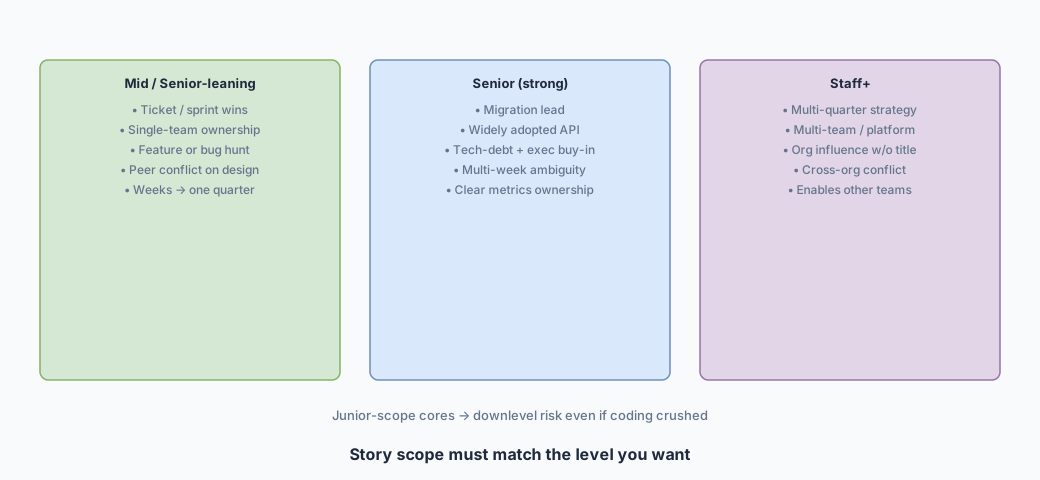
Senior stories that land well: leading a migration, landing a widely adopted API, getting leadership buy-in for tech debt. Staff stories go further — tech strategy over quarters, incident leadership across teams, architecture influence without a formal org chart title. If every core story is sprint-sized, the packet reads strong senior even when coding was staff-caliber.
Catalog for the level you want. Staff interviewers forecast whether you will raise their org’s bar — not whether you can close tickets.
Practice questions & sample openings
Question
Tell me about a time you took ownership of something outside your job description.
Signal: Ownership + scope
What they really want: Did you notice a problem, create a plan, get buy-in, and measure impact — or wait for a ticket?
- Follow-up: Who resisted and how did you handle it?
- Follow-up: What would you do differently at 10× scale?
Question
Tell me about a challenging project.
Signal: Perseverance (not system design flex)
What they really want: What wall did you hit, what did you try next, and how did you keep momentum?
Build a story catalog before the loop
Scrambling mid-interview burns working memory you need for delivery. Pre-build a catalog:
- 3–5 core stories — peak projects you’d lead with if you only had ten minutes with the hiring manager. Each should hit multiple signal areas.
- 5–7 filler stories — conflict, feedback, failure, mentoring, ambiguity — so you never stretch one project into every answer.
- Journal prompts — high-impact launches, incidents, disagreements, promotions, mistakes that changed how you work.
For each story keep a card: one-line stakes, 4–6 action bullets, metrics, learning, and tagged signals. Speak from the card — don’t memorize a script.
Staff catalog checklist. At least one platform/enabling story, one cross-org conflict, one multi-quarter strategy or incident arc, and one growth/feedback story where the change raised team or org standards.
Adapting stories for Big Tech scale
You do not need FAANG tenure. You need to think in ways that translate: users at scale, organizational blast radius, measurement, and pace.
- Reframe systems thinking — “We queried the DB directly, but I isolated the access layer so caching or replicas could drop in later.”
- Quantify impact — baseline → after, even if approximate (tickets/day, error rate, latency, eng-hours saved).
- Show coordination — who else had to agree, what you wrote down, how you sequenced risk.
Pre-interview checklist
- Map every catalog story to at least two signal areas.
- Prepare TMAY, proud project, and conflict cold (see The big three).
- Close each STAR story with a crisp Result — and one line on what you’d repeat next time.
- Practice out loud once on video; cut any opener longer than ~20 seconds of context.
- Skim the company’s values once and note 2–3 natural phrase fits.
Staff/Principal STAR answer banks
Pitfalls that quietly sink the round
Most behavioral rejects aren’t “bad people skills.” They’re mismatched altitude, weak Decode, or stories that don’t forecast how you’d behave on a hard week.
- Skipping Decode — answering the question you wished they asked.
- Senior story in a staff room — ticket heroics, no org leverage.
- Values cosplay — pasting Leadership Principles without a real decision.
- One story for everything — forcing the same epic into conflict, growth, and failure.
- No forecast — great past tense, zero signal for how you’d work here.
- Defensive on follow-ups — treating probes as attacks instead of depth checks.
Sample follow-ups (with answer sparks)
Expect these after any solid STAR. Prepare a spark — not a second speech.