
Why scalability matters
Scalability is how your system absorbs more users, more data, and more QPS without falling over — or without rewriting everything every festival season. In interviews, “we'll scale” alone sounds like hand-waving; you win when you name what scales, which hop hurts first, and what trade-offs you accept.
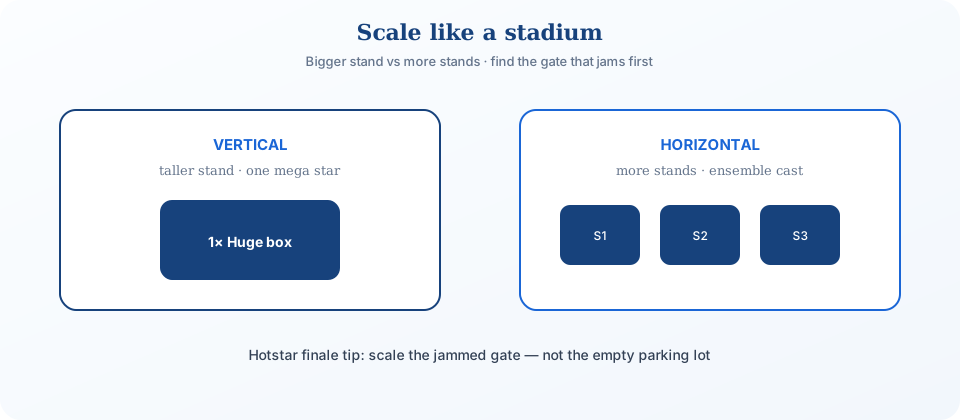
Think of it as capacity planning with a story. You're not promising infinite growth; you're showing that as load climbs from 1k to 100k concurrent users, you know which component saturates first, what lever you pull, and what you give up (cost, complexity, consistency, or latency). That narrative is what separates a senior answer from a buzzword dump.
Bigger box vs more boxes behind a load balancer.
Scale the hop that saturates first — not everything.
Clone apps freely; stores need partitions and care.
Different levers: cache/replicas vs sharding/queues.
How to say this in the interview
When the interviewer asks “how would you scale this?”, don't start with Kafka or Kubernetes. Open with a spoken paragraph like this — internalize this order, then customize the numbers to the prompt:
That four-beat answer — stateless apps → bottleneck → read/write levers → cheapest next step — signals you've operated systems. You can expand any beat when they dig in. Juniors often skip the bottleneck and jump straight to “shard everything”; seniors pause and name the saturated resource first.
Vertical vs horizontal scale
Vertical scale means buying a bigger machine — more CPU, RAM, faster disks. Horizontal scale means adding more machines and spreading traffic. Interviews lean horizontal because it forces you to discuss state, coordination, and partial failure. Vertical is still a valid chapter-one answer for an MVP; the senior move is saying when you'd stop going bigger.
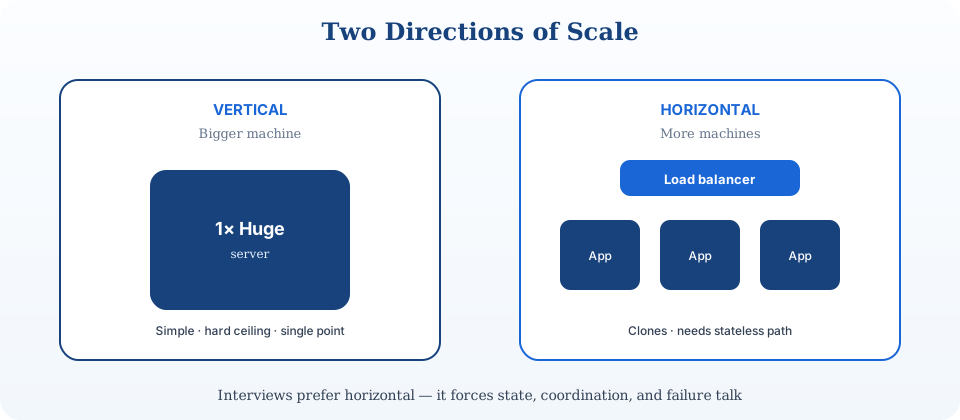
In practice, teams often ride vertical scale longer than textbooks admit. A mid-size Postgres on a large instance can handle tens of thousands of QPS for well-indexed reads. The trap is waiting until Friday night to discover the box has no larger SKU left — or that failover means downtime because you never practiced horizontal. So in an interview, frame vertical as the fast path to product-market fit, and horizontal as the plan you sketch once a single machine's CPU, memory, or network saturates and the next size jump is irrationally expensive.
- Vertical pros — simple; no sharding; great for early traffic.
- Vertical cons — hard ceiling; expensive; single point of failure risk.
- Horizontal pros — add capacity in increments; survive instance death.
- Horizontal cons — needs load balancing, shared state, and careful design.
A practical interview line: start vertical for the MVP story, then say when you'd go horizontal — usually when one box's CPU, memory, or network saturates and buying “even bigger” stops being rational. If they ask for numbers, a useful sketch is: one app box at 70% CPU under expected peak → add two more behind the LB before you touch the database; one DB at 80% IOPS under write peak → that's when sharding or write-ahead buffering enters the conversation.
Vertical is a bigger machine; horizontal is more machines — and horizontal forces you to talk about state and failure.
Find the bottleneck first
Don't scale everything. Scale the hop that saturates first on the critical path. Is it API CPU? Primary disk IOPS? Network egress from a media bucket? Name the resource out loud. This is the single highest-signal habit in system design interviews — and the one juniors skip most often because “add more servers” feels like progress.
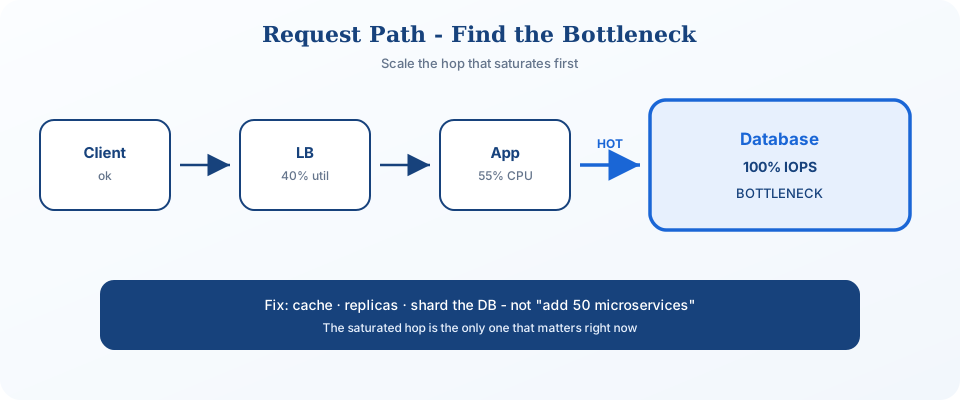
Walk the path like a detective. Draw client → CDN → gateway → app → cache → DB → object store. Assign a rough load to each hop from envelope math (users × actions × bytes). The first hop that hits ~100% of its budget is your design target. Fixing it often just reveals the next bottleneck — that's normal, not a failure of the design. Seniors expect the waterfall; juniors act surprised when “we scaled the API” and the DB melts next.
- Trace one request end-to-end on your diagram.
- Estimate load on each hop from envelope math.
- Identify the first resource that hits ~100% utilization.
- Design the next lever specifically for that hop.
- Re-check — fixing one bottleneck often reveals the next.
Name the saturated resource on the critical path, then apply one lever to that hop — not a rewrite of the whole system.
What juniors get wrong vs what seniors say
You don't scale a system — you scale the one bottleneck that's actually on fire.
This contrast is worth practicing out loud. Interviewers hear the junior version constantly; the senior version is shorter, more specific, and tied to a resource.
- Junior — “We'll use microservices and Kubernetes so it scales.” Senior — “The app is already cloneable; the primary's write IOPS will fail first at ~X QPS, so I'd shard or buffer writes before splitting services.”
- Junior — “Add Redis and it'll be fine.” Senior — “Cache helps if hit rate is high and staleness is OK; it doesn't help write throughput and can hide a hot key until the key expires.”
- Junior — “We'll shard by user_id from day one.” Senior — “I'd wait until one primary is the limiter; premature sharding costs ops and cross-shard queries before you need them.”
- Junior — “Horizontal scale means no downtime.” Senior — “Horizontal apps survive instance death; stateful stores still need failover, replicas, and a plan for split-brain.”
A failure story that lands well: a team autoscaled app pods from 10 to 200 during a sale because CPU looked high — but CPU was high because every request was waiting on a saturated Postgres primary. More pods made more connections and made the DB worse. The fix was connection pooling, read replicas for the heavy report queries, and a write queue for non-critical analytics — not more app capacity. Say that pattern and you sound like you've been on-call.
Juniors scale the visible layer; seniors scale the saturated resource — and they know more app pods can make a DB bottleneck worse.
Stateless vs stateful
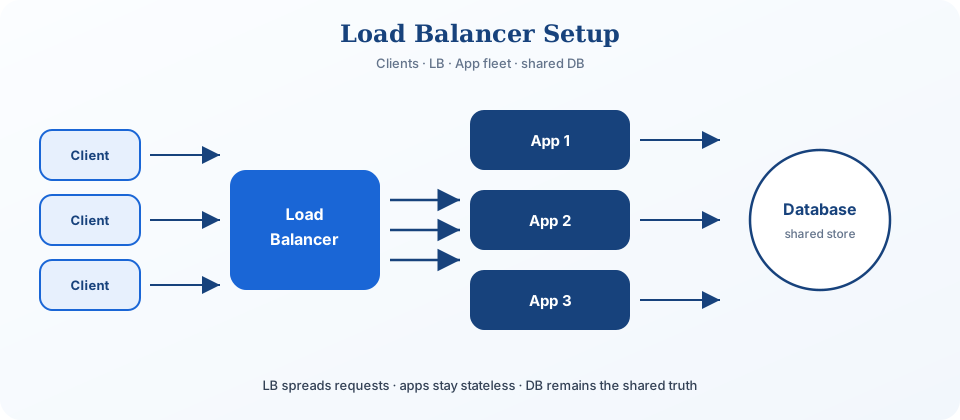
App servers should be stateless — any instance can handle any request. Session lives in Redis or a signed cookie, not in local memory on server #7. Stateless apps clone behind a load balancer without sticky drama. If you need sticky sessions “just for now,” call it technical debt out loud — interviewers respect honesty more than pretend purity.
Stateful stores are harder. You scale them with replication (reads), partitioning/sharding (writes and capacity), or both. Cross-shard queries get expensive — say that trade-off out loud. A shard key that looks even at 1M users can hotspot at 100M if celebrity accounts or a popular tenant dominate one partition. Plan for hot keys early even if you don't implement the special case on day one.
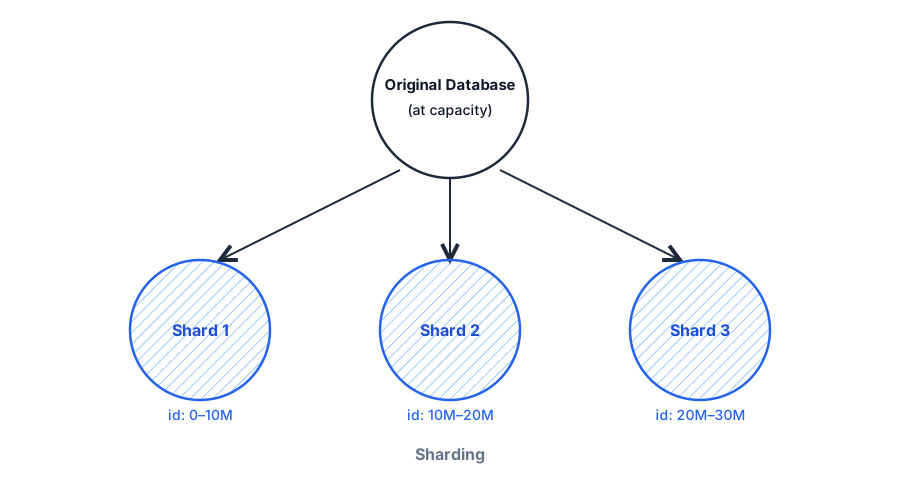
- Stateless apps — scale by cloning; put sessions and temp state elsewhere.
- Stateful stores — partition by a clear key (
user_id,tenant_id). - Coordination — locks and leader election often become the new bottleneck.
- Hot keys — celebrity users need a separate fan-out strategy.
After you partition, watch for the next bottleneck: distributed locks, leader election, or a global secondary index that still funnels through one place. Horizontal scale moves the problem; it doesn't erase coordination. Seniors mention that second-order effect without being asked.
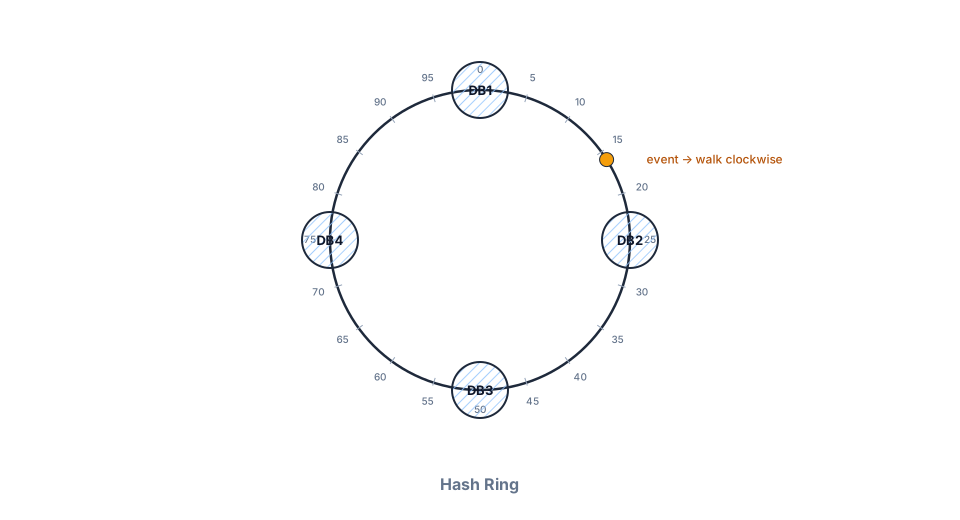
Make request handlers stateless so you can clone them; treat databases as the hard part and plan partitions early.
Scaling reads vs scaling writes
Reads and writes need different playbooks. Interviews love when you separate them instead of saying “add more servers” for both. A feed product might be 100:1 read:write; a telemetry ingest path might be write-dominated. Those two systems should not get the same architecture sketch.
For reads, you multiply copies and shorten the path: indexes, caches, read replicas, CDN for public content — full ladder in Scaling reads. For writes, you split ownership and absorb spikes: shard by key, batch or async via queues, append to a write-ahead log and materialize views later — full ladder in Scaling writes. If you only remember one sentence: reads love copies; writes hate contention.
- Scale reads — indexes, caches, read replicas, CDN for public content.
- Scale writes — shard by key, batch/async via queues, write-ahead logs.
- Asymmetric systems — feeds are read-heavy; telemetry ingest is write-heavy.
- Say the ratio — e.g. 100:1 read:write justifies aggressive caching.
Reads lean on cache and replicas; writes lean on partitioning and async — never treat them as the same problem.
A practical scale checklist
Use this as an interview spine when the prompt says “scale to 100M users.” Walk it top to bottom; skip what doesn't apply. The order matters: each step buys capacity with less irreversible complexity than the next. You don't need every ally for every seat — pick the minimum winning set of levers.
- Stateless path — make the request path mostly cloneable.
- Cache hot reads — edge or app-tier Redis for repeated lookups.
- Partition writes — even key; call out hot-key risk.
- Queue non-critical work — email, analytics, fan-out off the sync path.
- Measure and iterate — scale is a loop, not a one-shot redesign.
After each lever, remeasure. Cache might drop DB read CPU from 90% to 40% and suddenly network egress or the auth service is the limiter. That iteration story — “scale is a loop” — is more credible than a big-bang redesign drawn in one breath.
Stateless apps, cache hot reads, partition writes, queue side work, then remeasure — in that order of habit.
Phrases that land in interviews
Memorize these patterns — they show you've built systems, not only watched YouTube explainers. Drop one when you feel the answer getting vague; specificity resets the conversation.
- “We can scale reads horizontally; writes need sharding or a write-ahead log.”
- “This path is stateless — we add instances behind the load balancer.”
- “Celebrity users become hot keys — we need a separate fan-out strategy.”
- “At 10× traffic I'd revisit partition boundaries and cache hit rates.”
- “The bottleneck is primary IOPS, not the API tier — so I wouldn't add more app pods yet.”
Say which direction you scale, which hop is the limiter, and how you'll handle state — that trio beats buzzwords every time.
Cost and performance levers
Scale ladder with examples
10× growth questions
Ask yourself: What saturates first — single DB CPU, network egress, lock contention, or cache memory? Your next architecture change should target that, not a random new technology.
Failure modes to mention
Call out at least one dependency failure (DB down, cache stampede, queue lag, region outage) and your mitigation (timeouts, retries with jitter, degraded mode, circuit breaker).
Interview Q&A by level
Practice saying these out loud for scalability. Interviewers grade clarity and judgment more than buzzwords.
Match depth to the bar: define → trade off → operate. Don't dump principal answers in an entry-level screen.
How to answer this in a backend interview
Measure → fix the current limit
Bigger box until economics fail
Stateless app tier scales easily
DB, cache, queues — design the sticky parts
QPS, payload, storage growth
When asked how I'd scale, I start with napkin math: QPS, payload size, read/write ratio, and where state lives. Stateless app servers behind a load balancer scale horizontally; the database doesn't. I'd climb the ladder — index, cache, replicas, then shard or specialize — instead of drawing Kubernetes on slide one. Each step names the bottleneck it removes and the new failure mode it introduces.
Related Lattice posts: Numbers to know · Scaling reads · Scaling writes · Sharding