
Not enough to go around
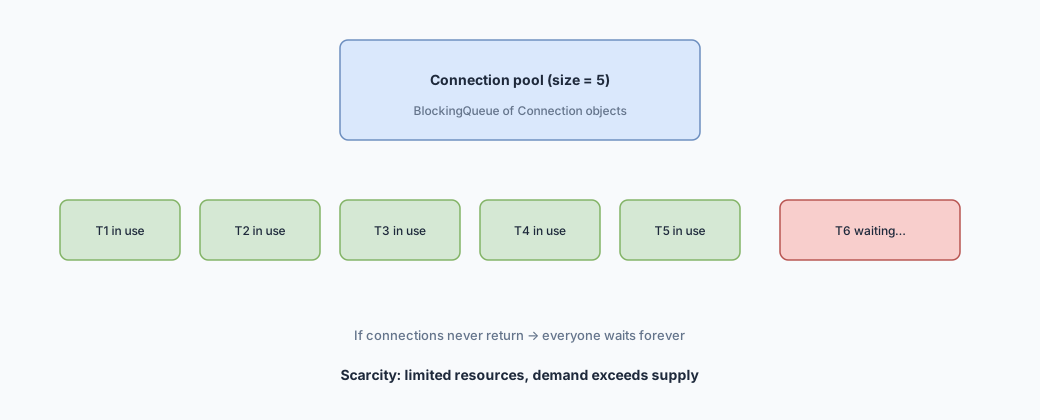
Scarcity is demand exceeding supply: finite DB connections, memory budgets, expensive objects created once. The failure mode isn’t silent corruption — it’s hanging, timeouts, or overload while the downstream system looks “fine.”
Five connections checked out and never returned → new requests block forever. Monitoring may show no crashes; users just spin. You must track in-use capacity, block or fail when empty, and wake waiters on release — always release in
finally.Analogy: limited parking permits
Scarcity is a building with N parking permits: a semaphore hands out permits and takes them back. A connection pool is a set of loaner bikes — acquire one, ride, return it (or replace it if the chain breaks).
Semaphores — limit concurrent operations
A counting lock: N permits. Acquire before work, release in
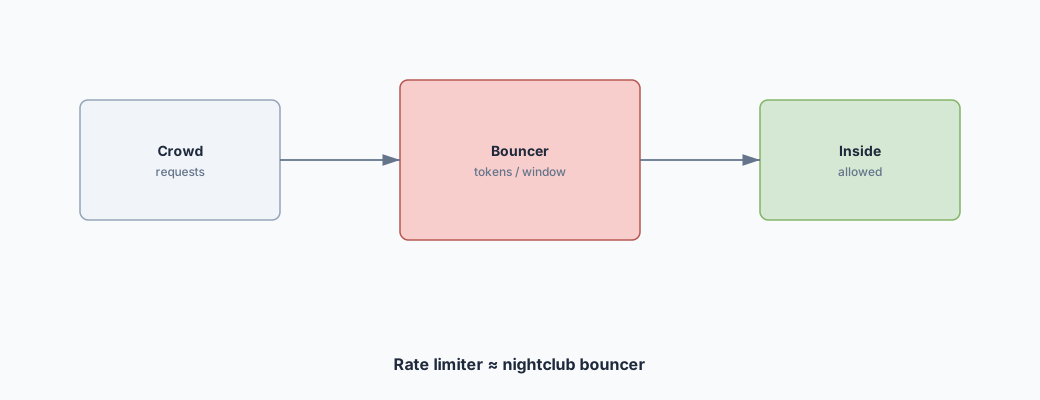
finally. Nightclub bouncer analogy: capacity tokens. Perfect when you don’t need to hand out a specific object — only “at most N in flight.”from threading import Semaphore
class APIClient:
def __init__(self, max_in_flight: int = 5):
self._permits = Semaphore(max_in_flight)
def request(self, endpoint: str):
self._permits.acquire()
try:
return self._http.get(endpoint)
finally:
self._permits.release()import java.util.concurrent.Semaphore;
class APIClient {
private final Semaphore permits;
APIClient(int maxInFlight) {
this.permits = new Semaphore(maxInFlight);
}
Object request(String endpoint) throws InterruptedException {
permits.acquire();
try {
return http.get(endpoint);
} finally {
permits.release();
}
}
}- Download manager — Semaphore(3)
- Image/video pipeline — cap CPU-heavy jobs
- External API wrapper — respect concurrent request limits
Resource pooling — hand out real objects
Connections/GPUs have state. A semaphore limits count but doesn’t give you the object. Use a bounded blocking queue preloaded with resources:
take/get to acquire, put to release.from queue import Empty, Queue
import time
class ConnectionPool:
def __init__(self, size: int, timeout_s: float = 0.5):
self._q: Queue = Queue(maxsize=size)
self._timeout = timeout_s
for _ in range(size):
self._q.put(self._create())
def acquire(self):
try:
return self._q.get(timeout=self._timeout)
except Empty:
raise TimeoutError("no connection available")
def execute(self, query: str):
conn = self.acquire()
try:
return conn.execute(query)
finally:
self._q.put(conn)import java.util.concurrent.*;
class ConnectionPool {
private final BlockingQueue<Connection> q;
private final long timeoutMs;
ConnectionPool(int size, long timeoutMs) {
this.q = new ArrayBlockingQueue<>(size);
this.timeoutMs = timeoutMs;
for (int i = 0; i < size; i++) {
q.add(create());
}
}
Connection acquire() throws InterruptedException {
Connection c = q.poll(timeoutMs, TimeUnit.MILLISECONDS);
if (c == null) throw new TimeoutException("no connection available");
return c;
}
Object execute(String query) throws Exception {
Connection conn = acquire();
try {
return conn.execute(query);
} finally {
q.put(conn);
}
}
}- Always set queue capacity = pool size (never unbounded).
- Request paths:
poll/get(timeout)— fail with 503, don’t wait forever. - Optional: validate before handoff; discard & replace stale connections.
Limit aggregate consumption
Constraint is total units (MB bandwidth, buffer memory), not op count. Semaphore where each permit is 1 MB; acquire size, release size.
MB = 1024 * 1024


class DiskWriter:
    def __init__(self, budget_mb: int = 100):
        self._budget = Semaphore(budget_mb)

    def write(self, data: bytes, path: str) -> None:
        permits = max(1, (len(data) + MB - 1) // MB)
        # acquire N units of budget (Python Semaphore supports n)
        for _ in range(permits):
            self._budget.acquire()
        try:
            open(path, "wb").write(data)
        finally:
            self._budget.release(permits)
import java.util.concurrent.Semaphore;
class DiskWriter {
private static final int MB = 1024 * 1024;
private final Semaphore budget;
DiskWriter(int budgetMb) {
this.budget = new Semaphore(budgetMb);
}
void write(byte[] data, String path) throws Exception {
int permits = Math.max(1, (data.length + MB - 1) / MB);
budget.acquire(permits);
try {
java.nio.file.Files.write(java.nio.file.Path.of(path), data);
} finally {
budget.release(permits);
}
}
}Reuse expensive objects
DB pools, GPU contexts, scarce file handles — BlockingQueue of the real objects. Say: “Creation is expensive, so I’ll pool and return in finally.”
Maximizing utilization (advanced follow-up)
Governance stops overload. Infra / trading / AI loops may ask how to keep scarce resources busy:
- Work stealing — per-worker queues; idle workers steal (uneven task lengths).
- Batching — amortize acquire/release; trade latency for throughput.
- Adaptive sizing — grow/shrink pool with load (tune carefully).
Decision tree
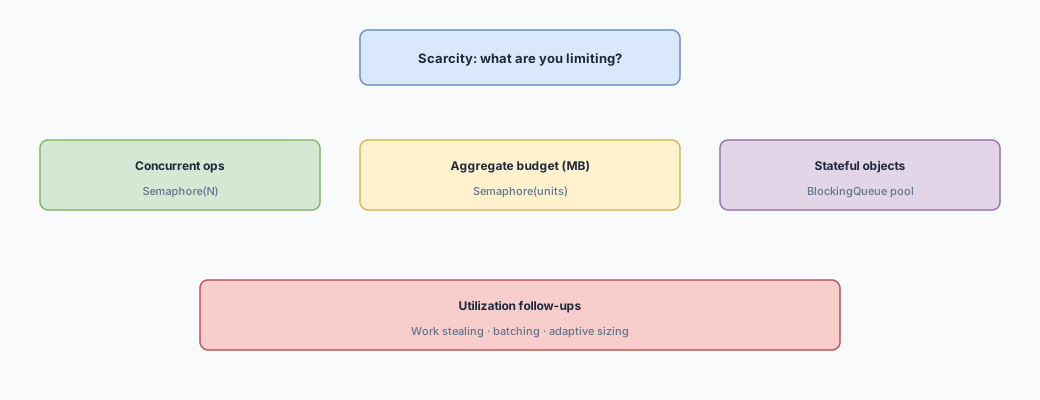
Worked mini-example: connection pool
pool = Semaphore(10)  # max 10 DB connections

def query(sql):
    pool.acquire()
    try:
        conn = checkout()
        return conn.execute(sql)
    finally:
        release(conn)
        pool.release()
Semaphore pool = new Semaphore(10); // max 10 DB connections
Object query(String sql) throws InterruptedException {
pool.acquire();
Connection conn = null;
try {
conn = checkout();
return conn.execute(sql);
} finally {
release(conn);
pool.release();
}
}Scarcity anti-patterns
- Creating a new DB connection per request with no pool.
- Semaphore limit without timeout — thread pileup.
- Pool size = thread count blindly.
- Ignoring utilization metrics when asked “is 10 enough?”
Scarcity checklist
- What resource is finite?
- What’s the max concurrent users of it?
- Acquire timeout / fail-fast policy?
- Release on all error paths?
- How do you tune under load?
Common interview pitfalls
These mistakes show up constantly on this prompt. Name the trap, then show the fix in your design — don’t wait for the interviewer to catch you.
- No limit — resource exhaustion.
- Limit without timeout.
- Pool sized randomly.
- Forgetting release in finally.
- Mixing scarcity with correctness-only answers.
Interview script (say this)
Read this once out loud before a mock. It’s the spine of a strong answer — not a script to recite robotically.
- Scarcity: finite sockets, GPUs, memory, rate budget.
- Semaphore or pool caps concurrency.
- Acquire with timeout; fail fast under overload.
- Always release in finally.
- Utilization guides sizing — not vibes.
- Example: 10 DB connections shared by 200 handlers.
- Reuse objects in pool to avoid allocate churn if relevant.
- Tie to rate limiter as scarcity of permits.
Extra verification traces
Walk these three traces on the board. If you can narrate them cleanly, your implementation section usually follows.
Staff-level follow-ups
At staff+, they twist the prompt. Answer in one sentence that names the seam — don’t redesign the whole board.
- Adaptive pool? — Controller scales pool with latency/CPU signals.
- Per-tenant budgets? — Hierarchy of semaphores: global + tenant.
- GPU jobs? — Same pool idea; queue + lease timeout.
Complete solution: connection pool
from queue import Queue, Empty
from threading import Lock

class Connection:
    def __init__(self, cid: int):
        self.id = cid
        self.closed = False

class ConnectionPool:
    def __init__(self, size: int, factory):
        self._factory = factory
        self._q: Queue = Queue(maxsize=size)
        self._created = 0
        self._lock = Lock()
        self._size = size
        for i in range(size):
            self._q.put(factory(i))
            self._created += 1

    def acquire(self, timeout: float = 2.0) -> Connection:
        try:
            return self._q.get(timeout=timeout)
        except Empty:
            raise TimeoutError("pool exhausted")

    def release(self, conn: Connection) -> None:
        if conn.closed:
            # replace broken connection
            with self._lock:
                conn = self._factory(self._created)
                self._created += 1
        self._q.put(conn)

# Semaphore(size) also works if connections are identical and recreate-on-error
# is simple — Queue is clearer when you hand out real objects.
import java.util.concurrent.*;
import java.util.concurrent.locks.ReentrantLock;
import java.util.function.IntFunction;
class Connection {
final int id;
boolean closed;
Connection(int cid) { this.id = cid; }
}
class ConnectionPool {
private final IntFunction<Connection> factory;
private final BlockingQueue<Connection> q;
private int created = 0;
private final ReentrantLock lock = new ReentrantLock();
private final int size;
ConnectionPool(int size, IntFunction<Connection> factory) {
this.size = size;
this.factory = factory;
this.q = new ArrayBlockingQueue<>(size);
for (int i = 0; i < size; i++) {
q.add(factory.apply(i));
created++;
}
}
Connection acquire(long timeoutMs) throws Exception {
Connection c = q.poll(timeoutMs, TimeUnit.MILLISECONDS);
if (c == null) throw new TimeoutException("pool exhausted");
return c;
}
void release(Connection conn) throws InterruptedException {
if (conn.closed) {
// replace broken connection
lock.lock();
try {
conn = factory.apply(created);
created++;
} finally {
lock.unlock();
}
}
q.put(conn);
}
}
// Semaphore(size) also works if connections are identical and recreate-on-error
// is simple — BlockingQueue is clearer when you hand out real objects.