
Handoff without burning CPU or memory

Analogy: take-a-number counter
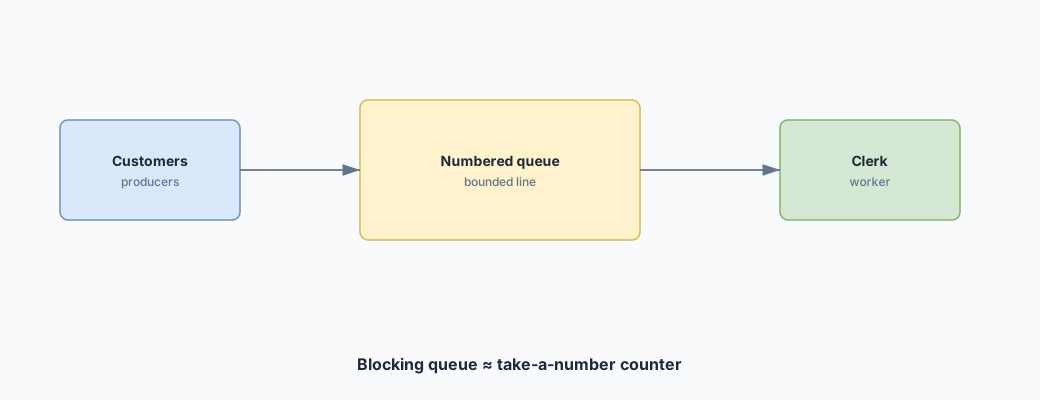
Coordination is a bakery take-a-number line: customers (producers) don’t shout at the clerk; they queue. If the ticket dispenser is full (bounded queue), new customers wait outside — that’s backpressure — instead of stuffing infinite people into the shop (OOM).
Condition variables (know, rarely code)
notify_all / separate conditions for “not empty” vs “not full” unless you’re sure one waiter can proceed. In interviews, jump to blocking queues.Blocking queues (default answer)
put blocks when full, get/take blocks when empty. Synchronization, waiting, and backpressure built in.from queue import Queue
from threading import Thread
class TaskScheduler:
def __init__(self, capacity: int = 1000):
self._q: Queue = Queue(maxsize=capacity)
def submit(self, task) -> None:
self._q.put(task) # blocks if full
def worker_loop(self) -> None:
while True:
task = self._q.get()
try:
task()
finally:
self._q.task_done()import java.util.concurrent.*;
class TaskScheduler {
private final BlockingQueue<Runnable> q;
TaskScheduler(int capacity) {
this.q = new ArrayBlockingQueue<>(capacity);
}
void submit(Runnable task) throws InterruptedException {
q.put(task); // blocks if full
}
void workerLoop() throws InterruptedException {
while (true) {
Runnable task = q.take();
task.run();
}
}
}- Always bound capacity — size ≈ worker_rate × burst_seconds (e.g. 100/s × 10s = 1000).
- Full queue options: block (
put) for internal pipelines; timeout/reject on request paths; drop+log for lossy analytics. - Shutdown: interrupt / poison pill /
getwith timeout + flag.
Message passing / actors (alternative)
Pattern: process requests asynchronously
def signup(self, email: str, name: str) -> None:
    self.users.save(email, name)
    self.email_queue.put(EmailTask(email, "welcome", name))
    # return immediately — worker sends mail later
void signup(String email, String name) throws InterruptedException {
users.save(email, name);
emailQueue.put(new EmailTask(email, "welcome", name));
// return immediately — worker sends mail later
}Pattern: absorb bursty traffic
# Pseudocode: offer with timeout on the request path
ok = purchase_queue.offer(request, timeout_ms=100)
if not ok:
    raise ServiceUnavailable("try again")
// Pseudocode: offer with timeout on the request path
boolean ok = purchaseQueue.offer(request, 100, TimeUnit.MILLISECONDS);
if (!ok) {
throw new ServiceUnavailableException("try again");
}Decision tree
Worked mini-example: bounded queue backpressure
q = BoundedQueue(maxsize=100)

def producer(item):
    q.put(item)  # blocks when full — backpressure

def consumer():
    while True:
        item = q.take()  # blocks when empty
        process(item)
BlockingQueue<Item> q = new ArrayBlockingQueue<>(100);
void producer(Item item) throws InterruptedException {
q.put(item); // blocks when full — backpressure
}
void consumer() throws InterruptedException {
while (true) {
Item item = q.take(); // blocks when empty
process(item);
}
}Coordination is about handoff timing — not about whether balance += 1 is atomic.
Coordination anti-patterns
- Unbounded queues as “async” — memory death under burst.
- wait/notify without while-predicate loop (spurious wakeups).
- Fire-and-forget threads with no lifecycle.
- Actors namedrop with no mailbox semantics.
Coordination checklist
- Who waits for whom?
- What happens when the buffer is full?
- Is work CPU-bound or I/O-bound for async choice?
- How do you drain on shutdown?
Common interview pitfalls
These mistakes show up constantly on this prompt. Name the trap, then show the fix in your design — don’t wait for the interviewer to catch you.
- Unbounded queue as default async.
- Busy-wait instead of condition wait.
- No backpressure story.
- Actor buzzwords without mailbox.
- Ignoring shutdown/drain.
Interview script (say this)
Read this once out loud before a mock. It’s the spine of a strong answer — not a script to recite robotically.
- Coordination is producer/consumer handoff.
- Bounded queue gives backpressure when consumers are slow.
- wait/notify or blocking queue primitives.
- Async pipelines for email/resize/reports — not for seat invariants.
- Burst buffers absorb spikes then drain.
- Actors: single-threaded mailbox per entity as an option.
- I’ll pick queue vs callback based on overload behavior needed.
- Trace a full buffer: producer blocks or drops per policy.
Extra verification traces
Walk these three traces on the board. If you can narrate them cleanly, your implementation section usually follows.
Staff-level follow-ups
At staff+, they twist the prompt. Answer in one sentence that names the seam — don’t redesign the whole board.
- Drop vs block? — Policy by product — telemetry may drop; payments shouldn’t.
- Kafka? — Same coordination idea at infra zoom — say so, stay LLD if asked.
- Priority queues? — Still a handoff structure; starvation needs aging.
Complete solution: async logger (bounded queue)
from queue import Queue, Full
from threading import Thread

class AsyncLogger:
    def __init__(self, sink, maxsize: int = 10000):
        self._q: Queue = Queue(maxsize=maxsize)
        self._sink = sink
        self._alive = True
        self._worker = Thread(target=self._run, daemon=True)
        self._worker.start()

    def info(self, msg: str) -> None:
        try:
            self._q.put_nowait(msg)          # backpressure: drop newest
        except Full:
            # alternative: put() to block caller — say which you chose
            pass

    def _run(self) -> None:
        while self._alive or not self._q.empty():
            line = self._q.get()
            try:
                self._sink.write(line + "\n")
            finally:
                self._q.task_done()

    def shutdown(self) -> None:
        self._alive = False
        self._q.put("__STOP__")              # wake worker
        self._worker.join(timeout=5)

# Concurrency: many producers, one consumer — Queue is the lock.
# Never share the file handle across threads without its own lock.
import java.util.concurrent.*;
import java.io.Writer;
class AsyncLogger {
private final BlockingQueue<String> q;
private final Writer sink;
private volatile boolean alive = true;
private final Thread worker;
AsyncLogger(Writer sink, int maxsize) {
this.q = new ArrayBlockingQueue<>(maxsize);
this.sink = sink;
this.worker = new Thread(this::run, "async-logger");
this.worker.setDaemon(true);
this.worker.start();
}
void info(String msg) {
if (!q.offer(msg)) { // backpressure: drop newest
// alternative: q.put(msg) to block caller — say which you chose
}
}
private void run() {
try {
while (alive || !q.isEmpty()) {
String line = q.take();
if ("__STOP__".equals(line)) break;
sink.write(line + "\n");
}
} catch (Exception e) {
// log / rethrow as needed
}
}
void shutdown() throws InterruptedException {
alive = false;
q.offer("__STOP__"); // wake worker
worker.join(5000);
}
}
// Concurrency: many producers, one consumer — BlockingQueue is the lock.
// Never share the file handle across threads without its own lock.