Why this Q&A exists
Interviewers increasingly ask: "Would you use LangChain or LangGraph?" and "What's a Deep Agent?" The wrong answer is a brand monologue. The right answer is a stack story: harness vs framework vs runtime, then which agentic application type you're building.
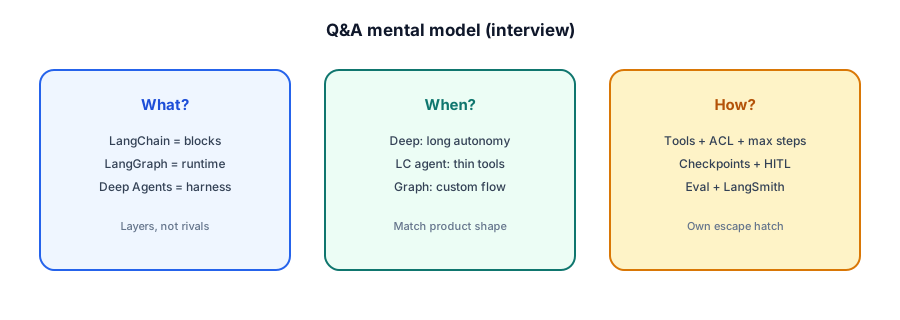
Harness · framework · runtime.
Long-horizon autonomy.
Nine product shapes.
Q&A for the room.
Pair with Agentic architectures (control models), Agentic patterns (ReAct, HITL, supervisors), Agentic frameworks (CrewAI, LlamaIndex, provider SDKs), and Context management with LangGraph (trim, summarize, store). This post zooms the LangChain ecosystem + product catalog.
Q: How do Deep Agents, LangChain, and LangGraph relate?
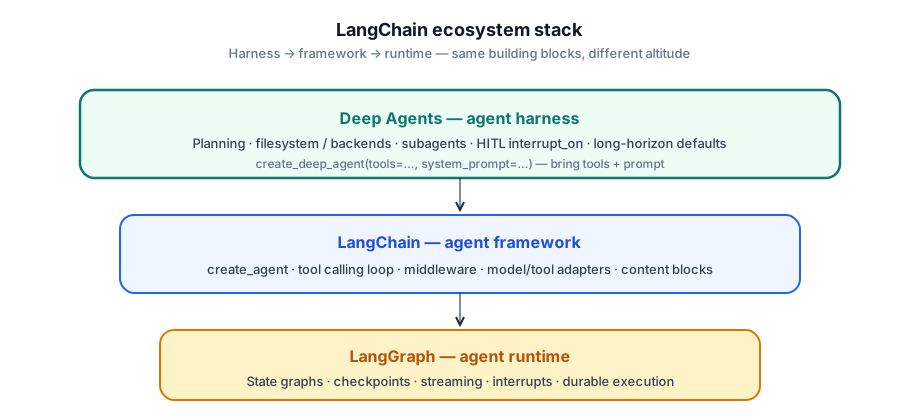
- Agent harness (Deep Agents, Claude Agent SDK, Manus-style CLIs) — batteries included for complex, non-deterministic, long-running work.
- Agent framework (LangChain, Vercel AI SDK, CrewAI, OpenAI Agents SDK, …) — abstractions for models, tools, loops, middleware.
- Agent runtime (LangGraph, Temporal, Inngest, …) — durable execution, persistence, streaming, HITL, low-level control.
Never say "LangChain vs LangGraph" as if they're competitors. Say "LangGraph runtime under LangChain agents; Deep Agents when I want the harness."
Q: What is LangChain good for now?
- Strengths — fast start, provider adapters, shared team patterns, middleware hooks (HITL, summarization).
- Limits — you still own prompts, tool ACL, eval, and blast radius; "LangChain" alone is not an architecture.
- Escape hatch — keep tool functions and policies in your repo so you can swap harnesses later.
Say this: "I'd use LangChain's create_agent for a support bot with five read tools. If we need refunds with resume and audit, I'd move the control plane to LangGraph checkpoints — or start on Deep Agents if the horizon is research-length."
Q: When do I drop to LangGraph?
- Best fits — checkout/KYC sagas, approval gates, routers that fan into specialist graphs, hybrid "workflow + agent" products.
- Primitives — nodes, edges, state, checkpointers, interrupts, subgraphs.
- Compose up — a
CompiledStateGraphcan plug in as a Deep Agents subagent when you need custom orchestration inside a harness.
LangGraph when control and durability are the product requirements; Deep Agents when long-horizon autonomy with defaults is; LangChain when the loop is simple.
Q: What makes Deep Agents different?
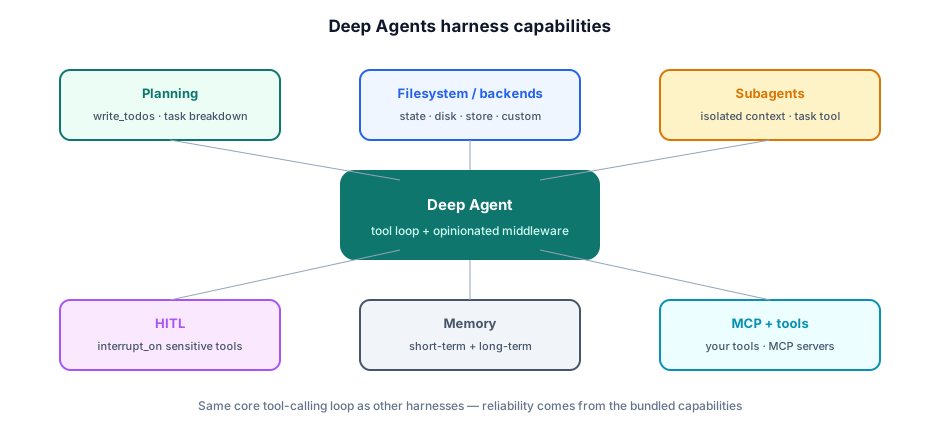
from deepagents import create_deep_agent

agent = create_deep_agent(
    model="anthropic:claude-sonnet-4-5",
    tools=[search_web, get_order, create_refund],
    system_prompt="You are a careful research and support agent.",
    # interrupt_on={"create_refund": True},  # HITL on money moves
)

# Bring tools + prompt; harness supplies planning, files, subagents, durability.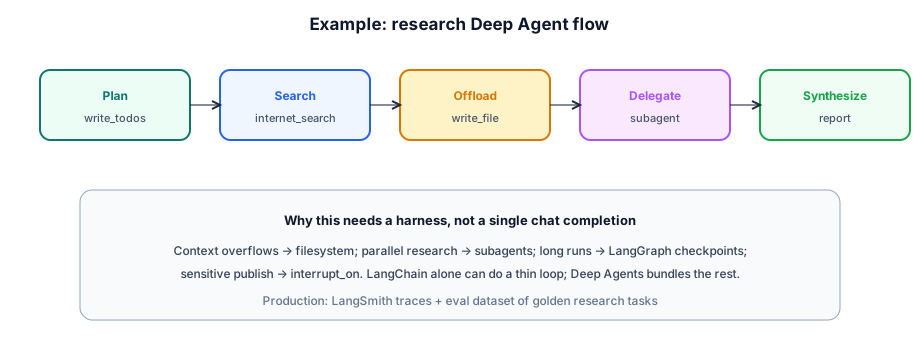
Q: How do I choose between the three in an interview?
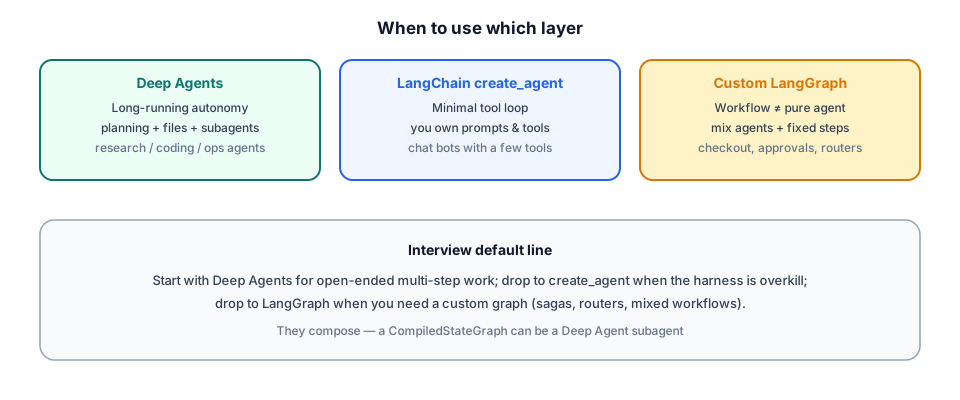
- Open-ended, multi-step, long-running (research report, coding agent, ops investigation) → Deep Agents.
- Short tool loop, few tools, clear stop (FAQ bot that can look up orders) → LangChain
create_agent. - Mix of fixed business steps + agentic hops (KYC → risk score → human approve → payout) → custom LangGraph.
- Knowledge-only Q&A → start with RAG; don't force an agent harness.
Q: What types of agentic applications can we build?
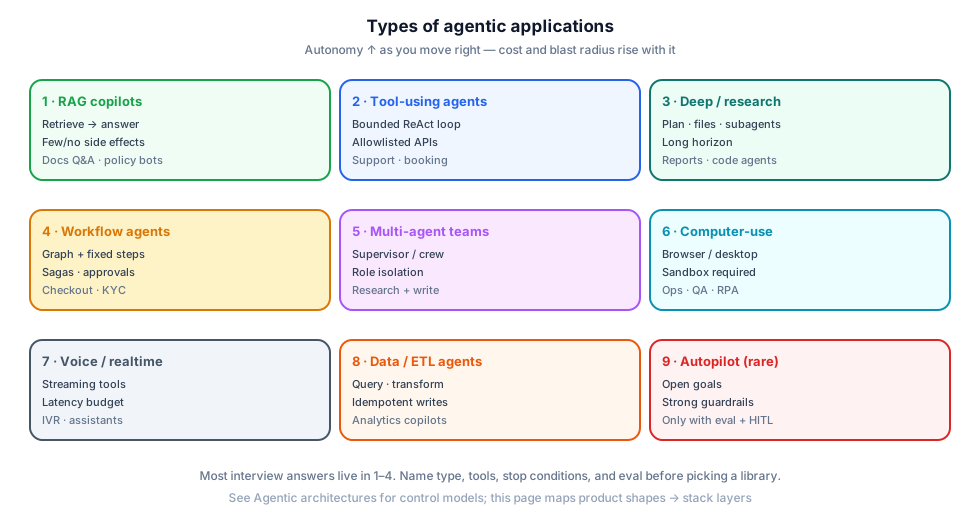
1 · RAG copilots
Job: answer from company knowledge. Side effects: none or soft (open ticket). Stack: RAG + light tool loop; LlamaIndex/Haystack for ingest; agent optional. Example: policy chatbot, internal wiki assistant.
2 · Tool-using support / ops agents
Job: look up + act within a bound. Side effects: refunds, resets, bookings with ACL. Stack: LangChain create_agent or LangGraph with HITL on writes. Example: "Order #8821 arrived broken — replace or refund?"
3 · Deep / research / coding agents
Job: multi-hour investigation, report, or PR. Needs: planning, context offload, subagents. Stack: Deep Agents (or Claude Agent SDK). Example: competitive research memo; "find flaky test root cause and open a PR."
4 · Workflow / saga agents
Job: mostly deterministic business process with LLM hops. Stack: LangGraph (or Temporal) + optional agent nodes. Example: KYC onboarding, insurance claim triage with human approve.
5 · Multi-agent teams
Job: specialist roles (research → write → review). Stack: Deep Agents subagents, LangGraph supervisor, or CrewAI for demos. Trap: more agents ≠ more quality — isolate context for a reason. See Agentic patterns.
6 · Computer-use / browser agents
Job: drive UI when no API exists. Must-haves: sandbox, screenshot budgets, step caps, domain allowlists. Stack: harness + sandboxed runtime; never raw prod credentials.
7 · Voice / realtime assistants
Job: spoken turn-taking with tools. Constraint: latency; shorter tool loops; careful barge-in. Stack: streaming runtime + thin agent; Deep Agents only for async follow-up work after the call.
8 · Data / analytics / ETL agents
Job: query warehouses, draft transforms, propose dashboards. Must-haves: read-only by default, idempotent writes, SQL dry-run. Stack: tool loop + strong schemas; Deep Agents when multi-hour exploration.
9 · Autopilot (rare in interviews)
Job: open goals with unsupervised side effects. Reality: only with eval gates, blast-radius isolation, and human escape hatches. Most "autopilot" products are type 3 or 4 in disguise — say that out loud.
Q: How do I map app type → stack?
| App type | Default stack | Escalate when… |
|---|---|---|
| RAG copilot | RAG + optional create_agent | User asks for actions → tools + ACL |
| Support agent | create_agent or LangGraph + HITL | Long investigations → Deep Agents |
| Research / coding | Deep Agents | Custom saga around it → wrap in LangGraph |
| Workflow / KYC | LangGraph / Temporal | Exception handling → agent node |
| Multi-agent demo | Subagents / CrewAI | Prod → supervisor + eval + fewer roles |
| Computer-use | Harness + sandbox | Always HITL for money / PII |
Q: What fails in production?
- Context blow-up — tool dumps megabytes into the prompt → use filesystem backends / summarization (Deep Agents' reason for existing).
- Non-idempotent tools — retries double-refund → tool design, not model magic.
- Unbounded loops — missing max steps / token budgets → page the on-call.
- Harness theater — Deep Agents for "what's our return window?" → wasted latency and $.
- No eval — shipping without golden trajectories → silent regressions after prompt tweaks.
Cost and performance levers
Rapid-fire interview Q&A
Classify the app type, pick altitude (harness / framework / runtime), then name tools, stop conditions, and eval — library last.
Interview Q&A by level
Practice saying these out loud for Deep Agents / LangGraph / LangChain. Interviewers grade clarity and judgment more than buzzwords.
Match depth to the bar: define → trade off → operate. Don't dump principal answers in an entry-level screen.
Wrapping up
Deep Agents is the harness for long, messy goals. LangChain is the framework for standard tool loops. LangGraph is the runtime when you need durable, explicit control — including under both of the above. Build from product type → altitude → tools & guardrails → library footnote.